

Parts Readiness
Parts Readiness gives every service order a score from 0 to 100 saying whether the job can be completed in one visit, with a reason for every deduction.
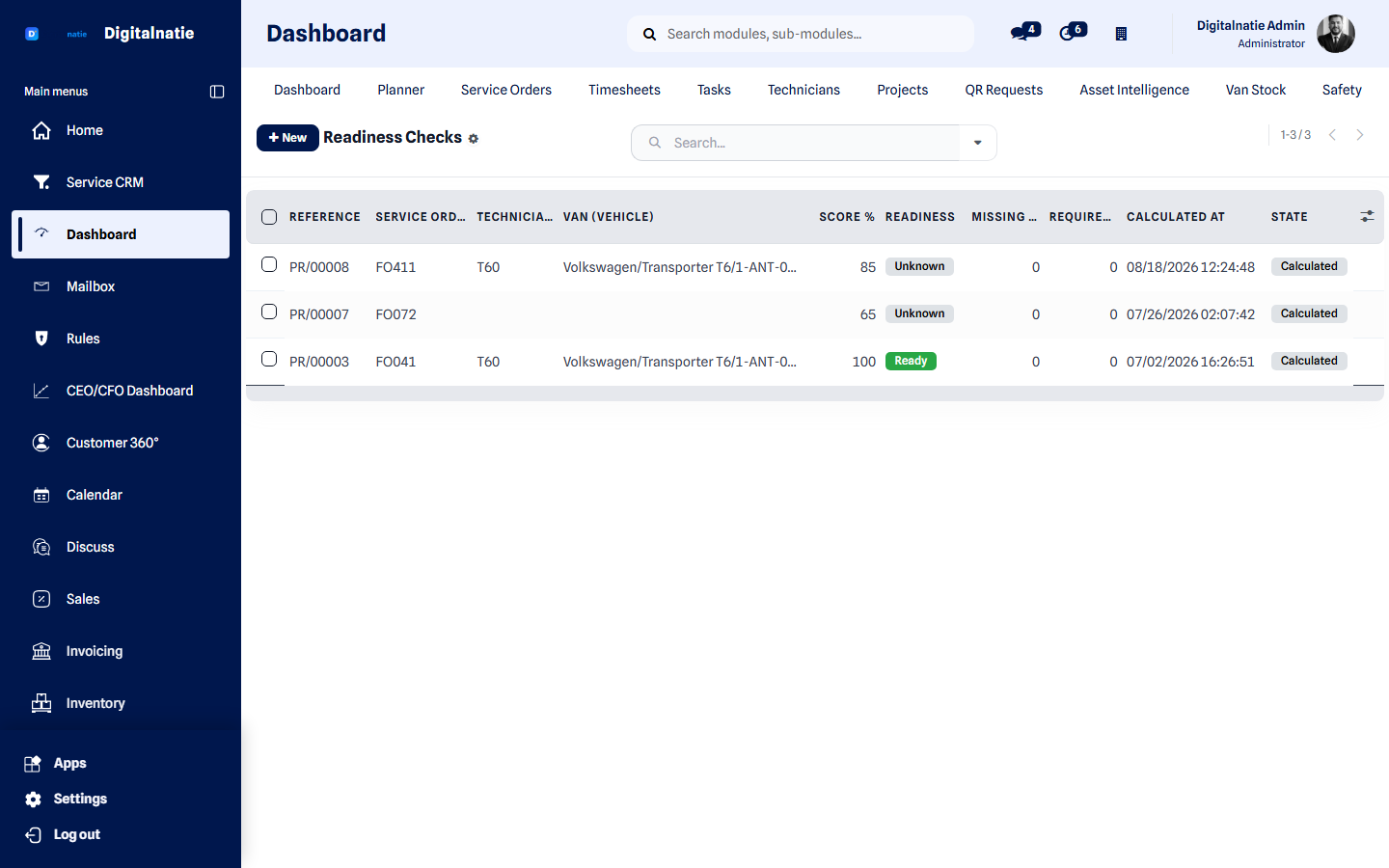 Per intervention: is everything ready to leave?
What you use this for
Section titled “What you use this for”- Checking before departure whether a job is fully doable.
- Seeing exactly which part is missing, and why.
- Finding a missing part in the warehouse, the assigned van or another van.
- Defining which parts normally belong to a type of intervention.
- Moving or completing a job rather than driving it incomplete.
Who can use it
Section titled “Who can use it”| Role | What they do |
|---|---|
| Planner or dispatcher | Reads the score and acts before the job goes out |
| Warehouse manager | Tops up the van or creates a transfer |
| Service manager | Manages the parts templates |
Prerequisites: the service order must have an assigned van, and your van stock and minimum levels must be current — the score is no better than your stock data. The check never moves stock itself.
How the score works
Section titled “How the score works” The score on a service order, with a reason for every deduction.
The check compares what the job needs with what is available in the assigned van and your warehouses.
What's needed ? What's available ? │ │ └──────────┬───────────────┘ ▼ Readiness 0 – 100 │ ┌─────────────┼─────────────┐ ▼ ▼ ▼ Ready Partly ready Not readyEvery deduction comes with a reason in plain language — for example that a part is missing from the assigned van, or that the required quantity is not fully covered. So you never see just a number.
Parts templates
Section titled “Parts templates”You don’t have to relist requirements for every job. With a parts template you define per intervention type what normally belongs to it — “annual boiler service” always brings the same filters, seals and lubricants.
That makes the prediction of required parts reliable instead of dependent on whoever entered the job.
The parts finder
Section titled “The parts finder” A part with its location in the warehouse and in the vans.
Search by name, reference, barcode or category and immediately see every place the part is held:
| Where | Why it’s useful |
|---|---|
| Assigned van | Can the technieker leave right away? |
| Warehouses | Does something need collecting first? |
| Other vans | Is it with a colleague driving nearby? |
That last one is often the fastest solution: a part already in a van is closer than a delivery.
What you do with it as a planner
Section titled “What you do with it as a planner”-
Check readiness on the service order or in the overview of upcoming jobs.
-
On a low score, read the reasons — you then know exactly what is wrong.
-
Use the finder to locate the missing part.
-
Top the van up via Van stock, or move the job to a day when it will be ready.
-
Check the score again before you schedule definitively.
Best practices
Section titled “Best practices”- Build templates for your ten most common interventions. That is 80 % of the effect for 20 % of the work.
- Check readiness the day before, not the same morning. You then still have time to top up.
- Look at other vans first before ordering a delivery.
- Keep minimum levels per van current — the score is only as good as your stock data.
- Move a job rather than drive it incomplete. A customer understands a postponement better than two visits.
Troubleshooting
Section titled “Troubleshooting”Does the check move stock itself? Never. It advises; you decide and confirm.
What if a job needs no parts? Readiness is then complete — there is nothing to deduct.
Does this work with multiple warehouses? Yes, and with multiple companies.
Why is my score low when the part is in the warehouse? Because it is not in the assigned van. In the warehouse it only helps the technieker if someone hands it over.
Can I ignore the score? Yes. It is advice, not a lock.
Next step
Section titled “Next step”- Van stock — topping up the van
- Warehouse map — seeing visually where it is
- Products & parts — the part record
- Service orders — where the score appears
- Planning — moving jobs
- From warehouse to replenishment — the full chain