

Safety & Quality
Where the LMRA is the last look on site, Safety & Quality is about what you already knew when the work was planned — and about what you do when something went wrong afterwards.
Three things, and deliberately nothing more:
- Risk assessment — what this job is known to expose people to.
- Controlled procedures and checklists — the instructions that go with the work, at a known version.
- Non-conformities — what went wrong, and what you changed so it stops.
1 · Risk assessment
Section titled “1 · Risk assessment”This is the planning risk analysis, not the one on the shop floor. It is determined when the work is scheduled, from what you already know about the customer, the site, that site’s environment, the kind of work, the asset, its category and the contract.
Each source may add risks; the merged list is frozen onto the service order.
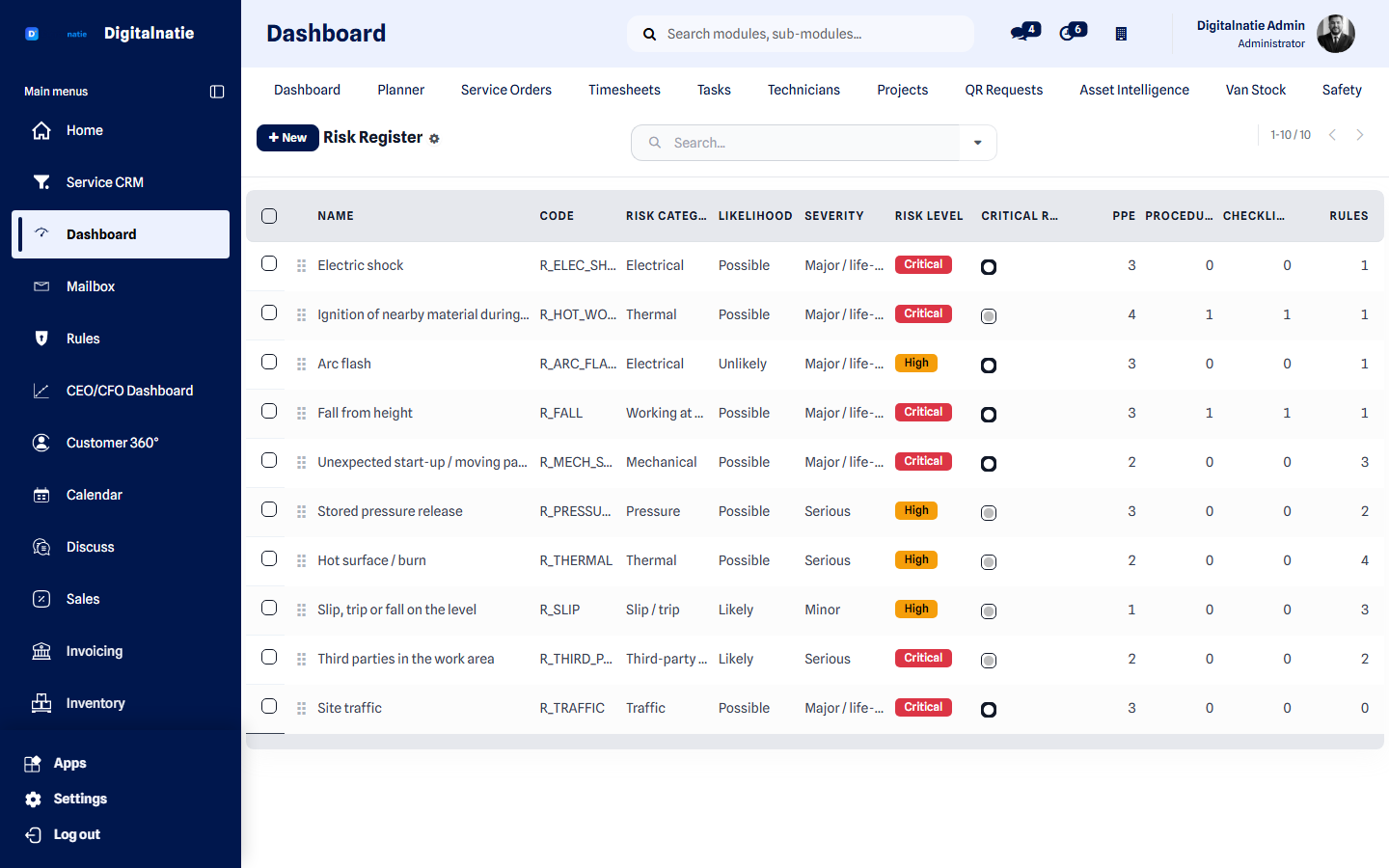 The risk register: each risk described once, with the protective equipment it demands.
2 · Controlled procedures and checklists
Section titled “2 · Controlled procedures and checklists”Documents with read-and-understood evidence
Section titled “Documents with read-and-understood evidence”A procedure, work instruction or safety rule can be marked acknowledgement required. The technieker then confirms read and understood — not in general, but against that exact version.
A critical procedure that has not been acknowledged stops the work. That is the only extra Start Work rule this module adds — PPE and LMRA each keep their own.
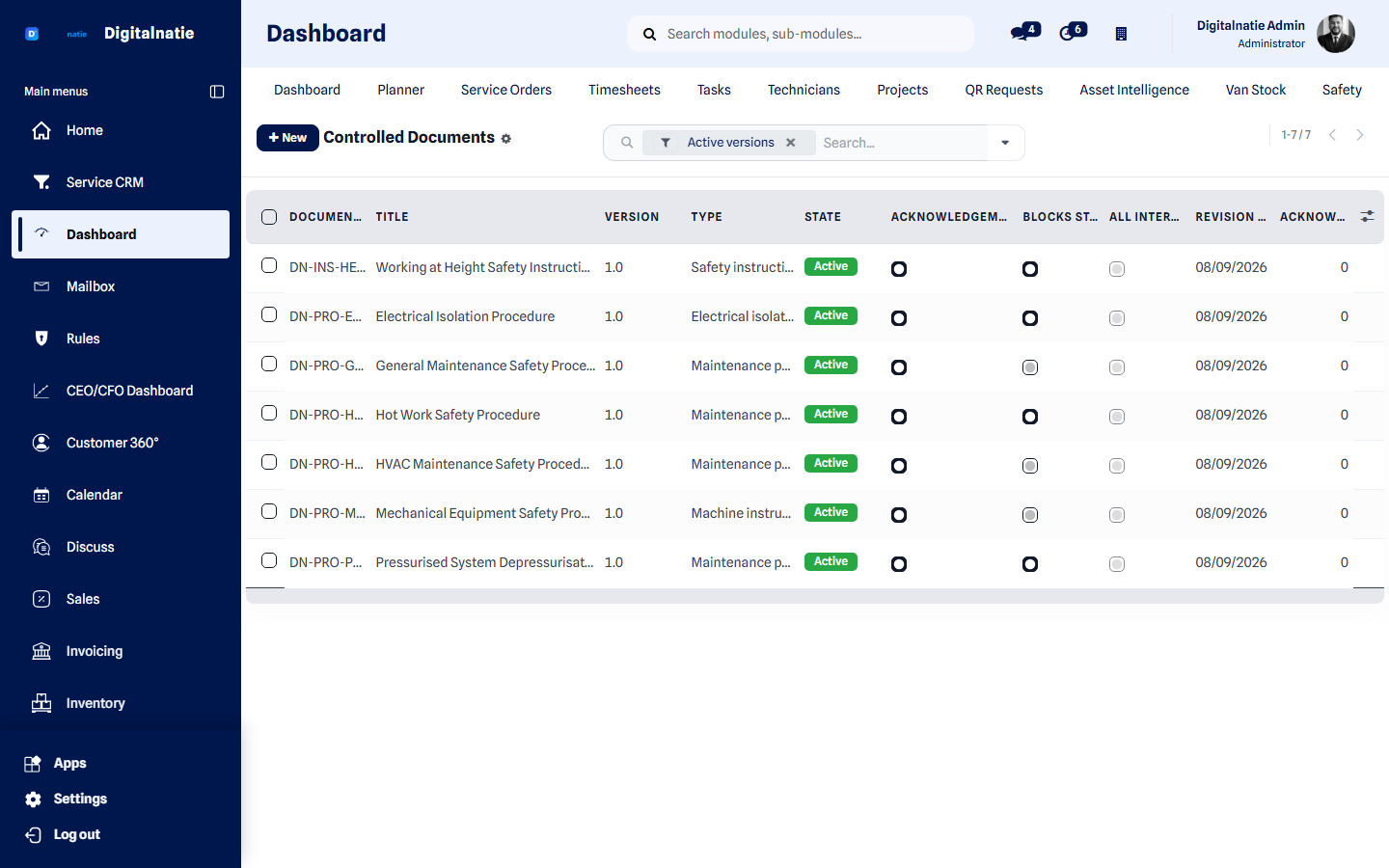 Controlled documents with their version and whether an acknowledgement is required.
Checklists
Section titled “Checklists”Checklists are the tick-lists that belong to the work: start-up checks, handover points, periodic inspections. They work like the documents — at a known version — and what was filled in stays with the intervention.
Failed points gather in Checklist failures, so you do not have to open every job to see where things go wrong.
3 · Non-conformities
Section titled “3 · Non-conformities”A non-conformity records three things separately:
| Question | |
|---|---|
| What went wrong | The finding itself |
| What was done immediately | The on-the-spot fix |
| What was changed | The corrective action meant to prevent recurrence |
That third column is where most systems stop and where this one is aimed. Closing a non-conformity can produce a new procedure version, a new checklist version or a new risk rule — without rewriting a single historical record.
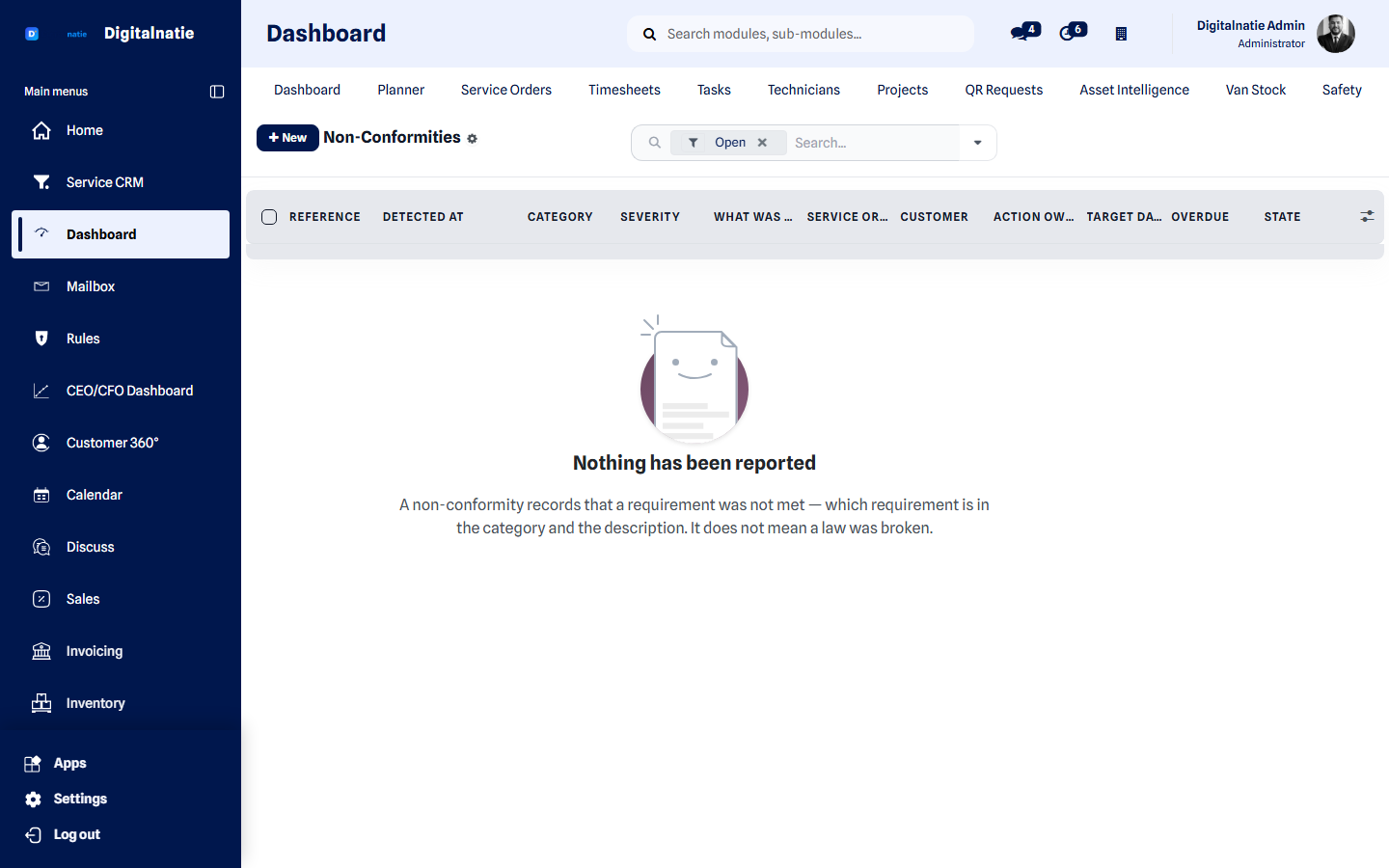 Non-conformities with their corrective action and due date.
Operational readiness on the service order
Section titled “Operational readiness on the service order”Every service order carries a Readiness block that puts the three stories side by side — PPE, LMRA and the procedures — without recomputing any of them. One glance tells you whether an intervention can leave.
What you find in the menu
Section titled “What you find in the menu”Under Dashboard → Safety:
| Menu | For |
|---|---|
| Non-Conformities | All findings |
| Overdue corrective actions | What is past due |
| Documents not acknowledged | Who still has to read which procedure |
| Checklist failures | The points that were not in order |
| Not safety-ready | Interventions that cannot start for safety reasons |
| Completed checklists | What was filled in |
| Acknowledgements | Who confirmed what, when |
| Risk Register and Risk Rules | The risks and who requires them |
| Controlled Documents | The procedures themselves |
| Checklist Templates | The tick-lists themselves |
| Site Environments | The environment types that bring risks |